Wednesday, 23 October 2013

Talkin' sex with Sue Johanson


     Midterms in university suck. Studying constantly for "Developmental Psychology: Childhood Through Adolescence" or "A Survey of Modern Asian History" really gets to you after a while, and drives pretty much everything else including your name and social life from your mind. One thing that, try as I may, I couldn't seem to forget was this image in the back of my mind of an 83-year-old lady testing vibrators on actor Tom Selleck's (rather nice) mustache. Now, this isn't some weird confession to a daydream I've once had, it's a video I saw on YouTube. To top it all off, Conan O'Brien was in the background making a variety of disturbed faces and the 7 foot, 425 pound wrestler "Big Show" was giving a booming laugh overtop of it all. But hey, that's just Sue Johanson for you, no boundaries. She then went on to teach Big Show exactly why "bigger may not be better" when it comes to sex, and teach Conan some basic sex toys he can make at home. Keep in mind that when I watched this, I was an 18-year-old (just turned 19!), and Sue was 83. It wasn't weird to hear what she was teaching, just weird because of her age (no offence, Sue). But I'd have to say the thing that topped the whole video off was the knowledge that I would be calling Sue Johanson the next day. All I could think was "what the hell am I getting myself into", little did I know it would be my funnest interview to date.
     Now, it seemed that everyone over the age of about 23 knew just who Sue Johanson was, including my parents. When I called my mom one day to catch up, I mentioned I'd be interviewing her. "You know, the lady from the show 'Talk Sex with Sue', my mothers reply was a laugh, and an 'of course I know who Sue is! How couldn't I'! Well, I was sort of confused. I guess she may of been more well known than I expected. From then on, when explaining my interview work to others, I'd bring up Sue and everyone would laugh and give the common 'really?! have fun with that one'! I was getting confused. I mean, an 83-year-old sex educator, I knew it would be interesting, but I didn't know just why everyone loved her so much. So I went to the ever trusty YouTube to see some clips of her show, and, well, Sue's just Sue. Let's say that. Finally, I had a way to explain her to people my age. The time had come, it was time to call Sue. "The Sex Lady", as my friends had come to refer to her as. So I sat down in my room, arranged my questions, and rung up her cottage number. Hilarity ensued.
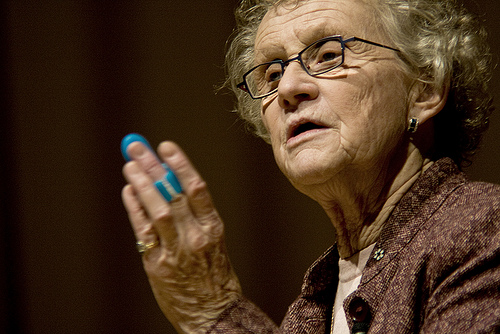
Sue Johanson, photo retrieved from


      Back in 1970, Sue Johanson started part one of the journey that, in my eyes, makes her a Canadian icon. I had read online (ever handy Wikipedia) that the then forty year old nurse opened "the first birth control clinic of it's kind in North America." But that's really all it said, which doesn't really explain anything. So, I started off our chat by asking just what that meant. It was a clinic just for kids, and it was 100% free. It provided services related to sex that children may of felt uncomfortable approaching family doctors for, with full anonymity, based out of a high school in the North York area of Toronto (Don Mills Collegiate). It provided children on the spot with contraceptives, pregnancy diagnosis, referrals, counselling, all without needing to talk to their parents. Now, I didn't really think that was allowed, or how a clinic like that would of been viewed, but in the span of the three minutes I had been chatting with Sue, I understood she wouldn't be offended in my asking. I learned two valuable things from her: first, in Canada, children of any age can be prescribed birth control without parental consent, and secondly, nobody ever voiced a concern about the clinic. According to Sue, "kids were having sex without a single clue about anything", so the free service was appreciated by many. Sue continued "we didn't even have to advertise, the grapevine among teenagers is absolutely awesome." An 83 year old describing anything as awesome is awesome in my books, this was the start of "that sex ladies'" journey. In the following 25 minutes, I learned Sue was so much more than that.
     The realization of her's remained in her mind. Kids were having sex, but didn't know a thing. Schools weren't teaching anything, "and parents sure weren't", so she decided to go back to school herself and take all the courses she may need to teach it sex, in a school, but not as a teacher. She felt by not going in as a teacher, she could have more freedom. That's how Sue started speaking in schools as a nurse from the Department of Health, with one goal in mind. Teach sex, no boundaries.
     She told me she started in high schools, but the real enjoyment came from public school. To Sue, the best was grade sixes. She told me she "LOVES, LOVES LOVES" grade sixes. She continued; "They're just so spontaneous, weren't shy, weren't bashful, just asked anything. They'd just put up their hands and say, Sue.. what's balls? So we went through... what's another word for balls? Nuts, they may say. Plunkers, they may say. Good. What else have you heard about them? Someone would say dink", and she would correct them, "No, that's not testicles, that's a penis". Just like that, no boundaries. Well, she was becoming more and more known, time for colleges and universities.

     Popularity for Sue was gaining fast, and soon speaking engagements in schools took her nationwide. After a while, she began her own radio call in show on Q107 out of Toronto, opening up her straightforward education to adults as well, which in itself was a hit. With it's affiliates across the nation, Sue was being heard around the nation, from St. John's, Newfoundland to Yellowknife, to Vancouver and US border cities, she didn't really care though, it was fun. From this, she started a television show (solely voluntarily, earning no income from it) on Rogers Television, doing about 50 shows a year. Although the show was only supposed to air in Toronto, she noticed something odd. She'd be walking down the street in Regina, Saskatchewan (whoa, just spelled Saskatchewan without spell-check), and people would notice her. It was then she learned her show was being "bicycled" around the nation. Meaning, they were showing it Canada-wide due to popularity. Man, Sue Johanson was becoming a big deal. 
     The Women's Television Network (WTN) asked Sue if she wanted to start a weekly show, which she agreed to (this was the show, I learned, that made her big). The Talk Sex with Sue program was a massive hit. I watched some clips, and needless to say, learned a lot. I mean, I'm sure anyone would. The problem with having radio and television programs 'simocasted' at the same time though soon arose. If she was using a flip chart to explain reproductive organs, or explaining the use of a sex toy, she'd have be way more descriptive on television than was needed for those listening on radio. Therefore, after 13 years, the radio show ended, "which was a shame." On record, I laughed when Sue mentioned sex toys. It may be immature, but hey, I'm young. It's funny when a senior mentions sex toys. From there, Sue was picked up by the Oxygen Network in the States. Over the span of half a decade, she was running two shows at once. A Canadian one, with Canadian callers, followed by an American one for American callers to call in with their questions. Sue was explaining sex North America wide, and couldn't be happier doing it. It's like a mindset I've always had, you never know if somethings going to work unless you try it. After 17 years on television though, things came to an end. New rules were implemented stating certain guidelines for what can be aired at certain hours, bumping Sue's show back many time slots. Unfortunately, her whole crew was volunteer and had other jobs to consider. A good thing came to and end, and she misses it terribly, more so, she misses the people she spent nearly two decades working with. I guess you never really think of things like that when a show ends.
     I had to ask, "what were some of the things talk about most." Sue told me it all depended on age. For young boys, it was how to make their penis longer. For girls, either how to make their boobs larger or smaller. For women? Well, Sue just told "us women should receive an Academy Award for how dramatic we made our orgasms seem. They were cataclysmic, well at least that's what the men thought." So essentially, how to reach that better orgasm. She told me though today the emphasis is on intimacy and emotion (from both sexes), something she's very glad to hear. Two things I learned from Sue, that quite frankly are two of the most amazing things about her, I didn't find online. I would love to share them.
     In season six of Sue's show, she introduced Dr. Keith Loukes to answer questions from homosexual viewers, an amazing addition in my opinion. She informed me if sex wasn't getting enough sex, homosexual sex was getting even less, so she was happy to include it. But the thing that touched me the most was a story she told me about her time during the AIDS epidemic. She knew many affected, and took them in to stay at her cottage where she was able to provide full care to them, whenever they may be in need. She told me she was a nurse, it was the least she could do. I think it's inspiring. Another thing she did was amazing in my opinion, and that was speaking in jails. In a complete volunteer role, she spoke at anywhere from Don Jail in Toronto to Kingston Penitentiary to groups of prisoners, explaining sex. To her, she say groups of uneducated men who really never learned the true, meaningful role of sex. Sue told me "those boys were so poliete to me, and I never had an issue. They always had great questions, and I was glad to answer." Sue saw people, as people. That's whats great about her. After her years of sexual education, Sue Johanson was awarded the Order of Canada in 2001 by Governor General Adrienne Clarkson, an honour that meant the world to her.

Sue explains, retrieved from
http://gnt.globo.com/gsat-images-web/fckeditor/image/350-sue-johanson.jpg

     But wait!! This is Sue Johanson we're talking about. We can't leave without something no-boundaries sexual. I asked Sue if their was anything that ever made her uncomfortable, and she replied no... but there was one question that sticks out, that when asked, she had to try as hard as possible to hold in her laughter. When I asked what it was, I couldn't hold mine in...

     "Well, it was this 80 year old lady who phoned in. She asked me, 'Sue, what's the best way to give my husband good head with my fake teeth in.'" 

     Yup, that's Sue Johanson for you. 

Sue leaving nothing to the imagination, retrieved from


Saturday, 21 September 2013

Josh Tiessen- Hanging Out with an Art Prodigy


     Back in June, 1995, I would of been a strapping almost one year old exploring my home down in London, Ontario, Canada. While I was discovering all I could on this continent, Josh Tiessen was born thousands of miles away, in Russia. How ever slim the chances may of seemed at that time, just over eighteen years later, both of us still only teenagers, we managed to meet up with each other at The Josh Tiessen Studio Gallery, in Stoney Creek, Ontario. We had the chance to talk about the adventure his life has been so far, and the one mine has been over the past ten months or so. Before we managed to sit down for an interview, Josh (such a polite guy...) asked how I had heard of him. Well, that in itself is a pretty funny story.
     This may sound like a really high-aiming dream, but it's one I've sort of always had. I've always wanted to have the title of “Top 20 Under 20”. You may of heard of the title before, (maybe a top under 30 or 40), but it's a pretty simple one to understand if you haven't. Pretty much, you've excelled in relation to others your age in a variety of possible fields, be it science, charity, the arts, or business, among many other options. I was bored one fine evening, and quite frankly decided to look at “my competition”, or what I was up against. It was Josh's write up that caught my eye right away, and it was for a pretty random reason that I was drawn to it. His bow tie. He had a massive bow tie on, and I thought it was absolutely amazing. It reminded me of Bill Nye the Science Guy for some reason. I figured I may as well look into this guy, after all, one of my dreams was always to go into art history when I'm older. His work I saw on his website was amazing, I decided I would try to meet him. An email was sent, an email received, and I was invited down.
Nice sign, Josh! Photo by Victoria Alexander

     When I arrived at the gallery in Stoney Creek, I faced an odd problem. I had no idea how to get into the place. I did what I thought was the best idea, and called the phone number at the end of his emails to see what I should do. I was surprised when it wasn't him who answered, but his dad. I'd never had to deal with the parents of people I've interviewed, but then again, I'd never interviewed someone my age. The phone was passed to Josh, and laughing, he went to the window and pointed my way in. What a way to first meet. After meeting Mrs Tiessen and looking at some amazing art done by Josh, I sat down in a very comfy armchair, and, well, you know the story of what he first asked me, how I knew him. But my first question for him was completely different. I was really curious about him being born in Russia, and asked if his family was of Russian descent. Nope. His parents were professors there, while at the same time doing some humanitarian type work based out of the city Krasnodar, if I heard him right, by the Black Sea.
     Josh stayed in Russia until the age of six, back when I was strapping seven year old, but while I was making my way through life at Bonaventure Public School, it was in Russia that a certain Russian nanny started noticing something in the young Josh, he was enraptured in art. She held up stuffed animals and would teach the young artist lessons on perspective and dimensions, with his parents smiling to the side, I would take the nanny's lessons with a bit of a smile too, Josh was only a young boy after all. By this time in my life, I had already won a Tim Hortons art contest for colouring really, really well in the lines. I won ten dollars, so take that Josh.
     Josh then left Russia to settle down about two hours from where I was, but again, what are the chances we would meet? Around the age of ten, I moved to the country-esque community of Ingersoll, Ontario, the place I would call home until university. Josh on the other hand joined a youth club, sort of like an after school program. While doodling on a name tag, he was noticed by a local artist by the name of Valarie Jones, who felt that Josh may of had some special talents. She asked the Tiessen family if there would be any interest in her mentoring Josh for a bit after school, once a week, so she could pass on some of her knowledge to the young artist. They agreed, and since Josh was home-schooled, there was some freedom in his schedule. It worked out perfectly. She would never touch his work, only teach some side lessons or give one or two words of advice along the way. During this time, he was introduced to acrylic paint and canvas, the medium he would stick to for the rest of his career.
Josh Tiessen and his art, by Victoria Alexander

      So, as I said, I've always had a huge interest in art history. I'm a big fan of some of the artists who rose to prominence in the French Revolution such as Jacques-Louis David and Eugène Delacroix, and I've been blessed enough to see some of both of their works in person at the Louvre, in Paris. But this is about Josh, so I thought it best to ask who some of his inspirations were. I was happy to hear Canadian painter Robert Bateman was up there on his list, because I knew that those two have had the chance to work together. When Josh would visit his grandfather, he would flick through a book of Bateman paintings that was kept on the coffee table there. With these in mind, Josh himself would work on nature paintings. Then, some started telling him that his work even reminded them of Bateman's. Well, as Josh told me, it could of just been family and friends saying that to make him feel good. Regardless, he took their advice and sent an email to Bateman, with some of his work attached. Not only did he received a reply, he also received an invitation. The famed painter invited Josh, only 15 at the time, to British Colombia for a week to study under him. It was what Josh called “an amazing experience”, and I bet it was! He had his work critiqued, and some pointers or advice given. One of them being that Josh should be upping his price for his work. Well, when someone like Bateman tells you that, you should probably listen.
     Now, I've had many crazy job aspirations over the years, but I think Josh had me beat. He had two, a painter, or a NBA player. After his first art exhibit though, he realized maybe art was the route for him, and “looking back at [my] chances at the NBA, for a short, white kid, well, they were next to zero.” His first show, arranged by Valarie but prepared by Josh, was a success. It was at the Joseph Brant Memorial Hospital in Burlington, and the first painting sold was surprisingly to a nurse, someone he didn't even know. That, Josh told me, made it seem all the better.
     I mean, I feel that the hospital show would be amazing. But sometime afterwards, Josh heard of an online contest for young artists. You were to submit an image of a piece of art online, and try to earn as much votes as possible. The top-voted pieces would be judged, and the three winners after judging would be put on display at the National Art Gallery of Canada. Josh, highly surprised, told me that he had been one of the paintings displayed, one of the greatest experiences he's had. CBC picked up on this, and reported about the winners. But another media source would help propel Josh's career, without really knowing it. That was the Huffington Post, with their article “10 Art Prodigies You Should Know” published July 27th, 2012. Josh, and some of his work, was listed in the article, but Josh had never referred to himself by the title “prodigy”. For those that may not know a prodigy, under one definition, is “a person, especially a young one, endowed with exceptional abilities”, which could be anywhere from music to math, or, of course, in art.
     The Tiessen family received a phone call from a professor researching prodigies who said she was based down in Ohio State University. She called to say she believed Josh was in fact an art prodigy, and wanted to come down to do some tests to find out for sure. After checking out her credentials, they invited her up and, as Josh told me, he's not really sure how, but in her time here she deduced that he was in fact a prodigy in art. But not just that, it was also deduced that he brother, a year younger than Josh, who excelled in music, was a music prodigy. He felt sort of weird having the title, but it did help spread his name as an artist, so it had it's benefits. Now him and his brother, Zac, are part of a study of 24 prodigies to track down just where some of these skills may have come from.
Josh and I chatting in the studio gallery (Mr Tiessen in background!)
Photo by Victoria Alexander

     Josh and I only had a short time together, but I had to ask one massive question before I left. See, I can't sit still for more than five minutes unless I have music playing (right now it's Young Forever by Jay Z feat. Mr Hudson), and I had to know, does Josh listen to music while painting? I would hope so! He paints about 8-10 hours a day, I would need at least something. He laughed and said of course he does, he loves it. Before he thought it would be a distraction, but now it helps block out all the little outside noises of a house, which I fully understand. But then, he one-upped me. He also occasionally listens to books, debates or lectures. Now that's dedication. It ranges from lectures to electronic pop, fair enough I guess.
     Next week, Josh will be down in Arizona for his first ever international art show, the the Tempe Center of Arts are part of the International Guild of Realism, in which he's their youngest member. That's pretty impressive in my books. It was great driving down and meeting Josh, and even cooler when he brought up the fact that he read my interviews before me coming, made me glad to hear.
Ever polite, as we were leaving, Josh apologized for realizing he wasn't wearing any socks (it's your house man, no worries), and laughed about what his mom called his duck feet. I know it may be random to add that last part, but I mean, those NBA teams may want to know about that before scouting the only known male art prodigy in North America, Josh Tiessen.
Josh and I in front of "Glimmer of Hope"
Photo by Victoria Alexander

     If you would be interested in seeing some of Josh's work... check out his website: http://www.joshtiessen.com/! 


Thursday, 5 September 2013

Of Gentlemen and Cowards pt. 2- Road to David Letterman


      The room around me was pretty empty, furniture wise at least. I was sitting on a questionable stool, with my photographer, Victoria, to my left. To my right, sitting on an amplifier, was Simon Edwards, singer in the band Of Gentlemen and Cowards. Across from me sat Josh Dawson, bass player for the band, and to the right of Josh sat Christian Fedele, guitar player. We all just finished laughing about how strange the band coming together was, but we were only started on their adventure. A group of four guys meeting at McMaster University (drummer Jake Warren was at work) and making it all the way to performing on the David Letterman show to millions, the start of a journey that's only just beginning.
     Although I'm writing this post weeks later, listening to music played on speakers by my roommate, I feel like my time with the boys down in Hamilton was only the other day. By about five minutes into our casual interview, I decided from now on I wouldn't question an interview opinion from Victoria again, these guys were awesome. Since then, she's suggested two other interviews that I should consider, needless to say, a certain Rob and Olivia are being planned now. Anyway, the band.
     Since Josh, at first, was the odd one out, it took a short while for them to reach the level of comfort their at now. Josh and Simon I was told became (in a short while) best friends and worst enemies. I understand what he meant right away, I can name some of those for sure. Josh and Christian right away bonded over shared musical interests, where as Jake and Josh took a bit longer to form a bond. They decided make a big decision right away, something that I would think would be a challenge for a newly formed unit. It was a decision that in a way seems really obvious, but at the same time one I never considered a band taking the time to do. They had to decide the future, and see if each of them had the same idea of an “end goal”. Where the wanted the band to end up and a unit, and how much work needed to be put in to reach their goal. They told me that they all had the same goal in mind. They decided Of Gentlemen and Cowards were going to be the next The Beatles.
     Okay, so that was followed by laughter as well, from all five of us there. Obviously that wasn't a reasonable goal, or one that they have ever seriously considered. But they all agreed that if they could be musicians full time, as in earn enough money from their shows to support a life for themselves, then they would be happy. After a short few weeks of practice came January 21st, 2011. Their first show. There was about eight people present, and it wasn't really their best. Simon dedicated a special number to his girlfriend, with a chair pulled up to her and everything. I was told they still poke fun at him for it, so, sorry Simon, had to bring it up for the other three guys.
     After that, they decided that the only reasonably thing to do was to go all out and get their name known no matter what. Between January and March they spent about $100.00 to record five songs and get the EP out like crazy. They laugh at the fact that this was their cheapest recording but their one with the most copies distributed. Man, the music industry can be a cruel. On March 5th, after their album boom, they played a show and sold about 150 tickets, packing the place. They looked at all the faces and knew something then. It was official, they were rock stars.

Josh (left) and Simon (right) performing at Supercrawl
Photo by Victoria Alexander

     Fast forward a few months. To a show in Ottawa, with the boys ready to kick off another concert on their first tour. Some shows had an okay amount of people, then there was this show. They paid the bar owner some money to ensure that their was no cover fee for those who came to the show. They spent the whole day advertising and getting their name out, and were excited at the interest people showed. It was time to begin, and the boys were about to play their first note to the crowd. But, there was no crowd.
      Not a single person showed up.
     Who would of expected that this moment, one that would personally crush me, would be one that would help pave their future? Well, it did. It was their musical epiphany. This wasn't going to be easy, there were going to be challenges and difficulties along the way. A thing they said once or twice before meant something more in that moment than it ever had or would before. No matter how many people were in the crowd, zero in Ottawa or millions watching on Letterman over a year later, they were only ever playing for four. Simon, Jake, Josh and Christian. They played to, and for, each other that night.
     The tour ended and they made their way back to McMaster. Chris, the sociology student who doubled as a sales manager at bootlegger, Josh who was in classical music as well as his job as a barista and baker, Simon, the engineering student who did research for the university, and Jake in his sociology program were back to their hometown. Back to their busy lives. They had to plan as much practice as they could around their education (they're all serious about their academics, and school is a high priority) and their work (they're university students after all, money was essential). Simon planned their master schedule, and social life took a hit, but one thing was different... they were playing shows (even better news... people were there!). Being in school helped form a solid and supportive fan base, allowing them to play formals, coffee houses, and even formal events all the way up to their university president. Things were looking up. That was when Josh heard about the contest that would lead to the bands biggest achievement to date.

Every band needs that one cover. (L to R): Josh, Simon, Jake and Christian.
Photo used with permission of Simon Edwards.

     As Josh described it, “I was on a site that gives bands opportunities to submit stuff.” Thanks Josh, elaborate. One contest he entered was related to a lower-budget movie called simply “We Made This Movie”. If your song received the most votes, it would be in the background of one scene. It was called the “Red Bull Sound Stage Choice Competition”. There were about 2000 to 3000 applicants, so he really had no care about the results. In the very fine print there was a memo, the winner would perform on their song The David Letterman Show. Still, it wasn't something Josh noticed. The band was really busy at the time, so they decided not asked people for votes. As one could guess, there weren't chosen by number of votes, and their slight chance was over. Then, they got an email.
     The producers of the movie had their twenty songs picked, but they also decided to choose another four songs from the entries to be in the movie as well, out of the remaining songs that were unsuccessfully voted in. Among them, the Of Gentlemen and Cowards song (one of my personal favourites) Save Me. That wasn't all, the boys found out they now had a one in twenty-four chance of a trip to New York. Now their thought processes changed. They had to be on Letterman.
     They took off with their voting plee to their collection of fans, Simon even taking time off work to be able to Facebook message anyone he could. Trying to be as successful as possible, they named their voting plee “Get McMaster on Letterman”. It was now up to their fellow university students to help them win their contest anyway they could. Tweets went out and statuses shared. They became stressed, under-slept, and cranky.
     They were in first, then fell to second. It was back and forth fighting for the last few days of the contest. Desperate times called for desperate measures, they reached out to celebrities via Twitter. It was the last thought they had as a last ditch effort. In the last twenty minutes of voting, they received a tweet from Dallas Green telling people to vote for them. They then received retweets from champion hockey player Hayley Wickenhesier and television host George Stroumboulopoulos. They thought they were in first, after not checking for a while, with twenty minutes to go. But within those twenty minutes of the contest remaining, the website for voting went down. They didn't see who was in first, they had no idea if they made it or not. An email was received.
     The winner would be announced in four days.

A photo of the boys meeting Letterman, courtesy of Simon Edwards.

     It's hard to draw the suspense out when I told you earlier that they did in fact have the chance to play at Letterman, but I tried, hope you it was thoroughly suspenseful! They won! They were going to perform on Letterman!
     They were flown down to New York and escorted around in shiny black escalades. They were rock stars after all! This was their second musical epiphany as a band. Their fans came together and helped them win an amazing opportunity. Their fans. Maybe they could make it after all.
     The boys think they broke a record, “the only band to grace the Ed Sullivan theatre with less than 1000 Facebook likes, or even a manager.” Walking in, and during sound check (during which they had the chance to jam with Paul Shaffer, leader of “The World's Most Dangerous Band”, providing the music for the Letterman show since 1982. As they were about to walk on stage, they looked at their Facebook page.            They made it, their 1000th “like” on the page.
     Ya. These guys were rock stars.
     With excitement, they reminded each other their motto. No matter who was watching, they were playing to four. They were playing to Simon, Josh, Jake and Christian.
     They saw their cue, and made it to the stage.

     Months later, I said goodbye to the guys, with the plan that we would keep in touch. Weeks later, I'm here finishing up their interview. On my iPod, I have a song playing called “Save Me” by a group of four guys from Hamilton, Ontario. A group of four guys who randomly met at McMaster University with big hopes. A song played live on the David Letterman show.
     Believe it or not, as much as Letterman was amazing, another part of their collective journey stuck out as a highlight. A certain type of fan. One who wasn't one of their friends, one who wasn't family or even a friend of a friend. Their highlight were the fans who were actual fans. Ones who gave them the time of day, the applaud and the cheer solely for the sake of musical merit.


      I found out Victoria was one of the first such people, and I'm glad she helped me get the chance to meet the four guys from Hamilton. The soon to be bigger than The-Beatles, Of Gentlemen and Cowards.

With the band. Hopefully we meet again!
Photo by Victoria Alexander

Thursday, 29 August 2013

Of Gentlemen and Cowards pt. One- Band Comes Together


     My photographer Victoria pitched an idea a few times but I always put it aside: “Why not interview the band Of Gentlemen and Cowards?” She had contact information for some members of the band and she thought they'd love to chat, but something always kept me from actually agreeing. I was hesitant for two reasons. First, I would be talking to four people--very different from my one-on-one chats. Second, it was my first venture into a music-related interview, and any new genre of interviews has inherent new challenges. However, how could I say I'm meeting all types of Canadians while excluding musicians? I agreed, and Victoria contacted them. I didn't really know much about the guys except for the knowledge that they attend McMaster University, and they recently had the chance to play on the David Letterman show (I'll explain that later). Driving to Hamilton to meet them, I realized I didn't even know their names. That's how blindly I was going in. 
        After pulling up to the house at which we'd agreed to meet, we wondered if we had the address right. It was an older looking house, and saying the lawn could use a trim would definitely be an understatement (no offence to your place, guys). Soon, I would learn that this is primarily the band's practice space. Whoa, a whole house to practice music! Dedication. After sitting and chatting a bit about what I was doing, and waiting for the three out of four band members that would be coming, we sat down in a backroom and made ourselves comfortable. So after a couple of weeks and an hour drive, I finally took Victoria's advice and took the time to meet Josh Dawson, Simon Edwards and Christian Fedele. Sorry fourth band member Jake, maybe we'll meet some other time.
Left to right: Christian Fedele, Josh Dawson and Simon Edward
Photo by Victoria Alexander


        In the words of one of Hugh Hefner's kids (I forget which), “some reporters have a story already written before the interview.” I've experienced that before, but not this time. I had no idea which angle to take, so I decided to start simply with "how did each of you personally get into music," with drastically different answers.
        Simon was thirteen years old when he received his first ever guitar, the day of his Bar Mitzvah. The thing was, musically he didn't have many role models at that point in his life. His mother is deaf, and his father is partially so, leaving only his sisters as family influences. This was the nineties, so their interest was naturally boy bands, boy bands, and more boy bands. These influences didn't speak to him very much, and it took until around university for him to really discover the rock music he would fall in love with. As he told me, he force-fed himself with thousands of songs, CDs and records, learning all he could. All the while, the cheap guitar from that Bar Mitzvah he received five years previous held a special hold on him. It was his first leap into instrumental music, having sung all his life, and it's an instrument he still keeps to this day.
        At around ten years old, Josh was given his first guitar, a Stratocaster, by his parents. Josh's family was a bit more musical, with his grandpa writing songs for the iconic Stompin' Tom Connors, among others. His father taught him a lesson in those early years that he remembers to this day: "you can sell everything in your room, but never your guitar." In about grade nine or ten, he started playing in a punk band that had about seven guitar players. They realized they needed a bass player, so Josh took the role. As soon as he had it in his hands, he loved it. He told me how he could feel the power; it was like holding a gun to the band and saying he could do whatever he wanted. Okay then...anyway, he stuck with it.
        Christian's mother received her Royal Conservatory certification in piano, whereas his father was once in a band called Shining Star. He started off with piano lessons from age 5-7, but he stopped because he told me how "piano sucks as a kid." I wouldn't know, I never took piano, I'll take your word. Then came music in school. He remembers how it was like Harry Potter, with a whole line of mouthpieces set up. Just like "the wand chooses the wizard," the mouthpiece chooses the musician, "it's not always clear why" as Ollivander would say. Christian ended up with the baritone sax, cool enough I'd say. This was mixed in with a brief musical theatre career (a short-lived stint as Kurt in The Sound of Music). One time though, he found his moms classical guitar, and went on YouTube to learn how to tune it. Drawing inspiration from "You Never Give Me Your Money" by the Beatles, Christian started his time as a guitar player. 
Simon and I... am I mid-laugh or something? Probably, hilarious guys.
Photo by Victoria Alexander

        But how did these guys even meet? They seemed like they've known each other forever, but I was far from right. Simon and Jake, I learned, knew each other from high school days. Together, they decided to go to McMaster University, Jake for sociology, and Simon for engineering. Around the second day, another new McMaster student, Christian, was walking down the halls of his residence when he saw some kid doing work, already, at his desk. Christian also noticed the guitar, and decided to introduce himself to the kid, whom he learned was named Simon. Boom, that's three out of four have met. That first year, Simon and Jake were in a few bands that weren't really going anywhere, and decided to try and get a little more serious. So at the end of the year, they left the others and recruited Christian, who by then was a friend who knew all their stuff. They practiced all summer, but realized they needed as bassist. Ads went up in student lounges, and a student a year older than them saw them and became interested. The undergrad halfway through his classical music degree was really just looking for someone to jam with, so he gave him an email saying he was interested. If you hadn't already guessed, that was Josh, and now the four of them all knew each other.
        Josh heard some of their stuff, and wasn't really a big fan of it. In fact, not at all. But he saw how intense Christian was rocking out and realized that was someone he could work with. He decided to give them a shot after all, and after a month, Christian, Simon and Jake told him that they were going to give him a shot.
            Of Gentlemen and Cowards was born.

TOMORROW: Read about their decision to try and become bigger than a university band, their very unsuccessful first tour, their "musical epiphany," and winning the chance to perform in front of millions on the David Letterman show.
Simon, Josh and Christian fooling around.
Photo by Victoria Alexander


Wednesday, 21 August 2013

Rob Furlong and his World Record Shot


     I honestly hate technology. You start to give it even the faintest bit of trust, and it goes behind your back and makes things difficult. Well, maybe on that hand, I should of just charged my iPod (which doubles as the recorder for most of my interviews) before I decided to call Robert Furlong. Anyway, as the phone call with Robert was wrapping up, my iPod died. With fingers crossed and silently fuming under my breath in the hopes I wouldn't be heard on the phone, I hoped the recording would of saved before the device shut down. It didn't. Once my iPod had enough charged to turn on again, I realized my whole phone call recording had never been saved. I ran to get a piece of paper and a working pen, then with the questions I had just asked in front of me, I closed my eyes and recalled most of the answers I could. My older brother has been awarded the distinctions with one of the best memories in Toronto (apparently they rank this), so I like to think my memory isn't too bad as a bit of runoff from him. What I realized though was that recalling all Rob said really allowed his answers to sink in more. I feel I'll be rethinking his answers for a while to come.
     With that in mind, there may be a few “specific” details missing from this particular interview, but that really isn't an important aspect to this one. In my opinion, in this particular conversation I had the chance to have, it was more the emotional aspects than the specifics that had the strongest prevalence. I've had the chance to discuss humorous careers, daring adventures, cooking, opera music, ballet, religion, ice road trucking, stunts, ultimate fighting, challenges and many more categories. This week, I've had two very different conversations regarding the death of a human being. A topic that's never very easy. Earlier this week I had the chance to speak with Carol Todd, the mother of bulling victim Amanda Todd who unfortunately took her own life in October. The story of meeting Carol is for a Canadian Stories book I'm working on. Meeting her took a lot of personal reflection, in regards to if I felt I was able to speak with someone about a sensitive topic such as suicide.
     Speaking with Robert was similar, yet very different at the same time. Rob and I spoke about a “world record” he held from March 2002 to November 2009. The record he held was “longest recorded sniper kill in combat”, a record he received while serving in Afghanistan during Operation Anaconda. Upon his spotter noticing a belligerent (enemy) soldier during conflict Shah-i-Kot Valley, Furlong took the shot that would kill the enemy soldiers life, a shot that was 2430m in length, a shot he would later learn had more significance than simply aiding the mission. I had to decide if I was up to speaking about such matters, if I felt Robert would like to talk after all these years (knowing he had spoken about it before) and had to consider if it was appropriate to write about. Needless to say, I made contact and we were in touch. At about three o'clock on Tuesday the 20th of August, I called Robert Furlong's cellphone. He was out east at a coffee shop taking a break and reading emails. That's when we started talking about his career with the Canadian Armed Forces.
 Rob Furlong, photo retrieved from 
http://algercafe.blogspot.ca/2011/05/longest-recorded-sniper-kills.html

     It was around 1997, the year after my little brother was born, when Rob decided to join the Canadian Armed Forces out east, becoming the first in his family to enter this profession (thanks, Rob). This is an instance were the recording would of came in handy, but I can let you know that he then went to Quebec for some training in a wide range of areas, yet it was what he would do outside of training that would effect his career, that being competition shooting. After people realized the talent he had there, he earned himself a spot (out of about two offered) in a more detailed sniper program, which Rob decided to go for.
     After training, came Robert Furlong's first deployment, he was off to Bosnia-Herzegovina as a peace keeper. What he would later realize here was how much more organized the bases were, the protocol and even things to do in your free time. He didn't really realize this then, as to him it was his first deployment as a soldier (well, peacekeeper). It was when Rob was sent to Kandahar Province, Afghanistan with the first deployment of Canadians and Americans that the comparison to Bosnia was made. They landed in an old air force base, and slept in two man tents. Rob made it to his first active war zone as a fighter, as a soldier. This is what he was trained for. Early on, he was stationed in an old, formerly Russian town with Anti-Taliban locals, a fellow Canadian and some Americans, mainly gathering intel. Then came Operation Anaconda, one of the first large-scale operations and battles in the war. 
     Somewhere in another area of conflict, a Canadian named Arron Perry would take a shot at a belligerent in a helicopter. This shot hit its mark, and unbeknownst to Perry, would set a world record for the longest in combat kill since a United Nations Marine Corps Gunnery Sergeant Sniper named Carlos Hathcock in 1967, Vietnam. Perry wouldn't hold this record for long. 
     With that going on in one area of combat, Furlong described to me what fighting in Anaconda was like, my first time hearing first-hand a soldier explaining what it was like in an active war zone. It seemed you were constantly being shot at or bombed at. You had very little solace, and when you did, you were planning tactics to strike back at the enemy to aid the mission. Mid-fight, his spotter noticed a troop down below in the Shah-i-Kot Valley. Rob took his shot, the enemy was neutralized, and fighting was continued without a second thought by many. After all, this was war.
     It was when he made it back to camp after the operation protocol was finished that stories started to spread about what he had done. He had beaten both Hathcock's and Perry's "record", and killed a man in combat from an astonishing 2430 meters, nearly 2.5 kilometers. 
The rifle used by Furlong
Image from http://en.wikipedia.org/wiki/File:Tac50.jpg

     How could one be proud to be know for this particular record? Be proud knowing that people know you as the man who took another life from an especially long distance away? Rob wasn't proud of that aspect, be he is proud he could successfully aid his country, and the protocols of the mission he was on. I say that's a pretty hard internal battle to fight. 
     I asked him what went through his mind when Canada left Afghanistan, and I received the longest pause in an interview I'd had ever been granted, before an answer. Of course he's glad that we're gone, and that soldiers can feel safe again with their families, and our nations out of war. But he remembers all his friends left behind, or brought home no longer with us, and wonders if they're really done in Afghanistan yet.

     While sitting at his desk one day at work, Robert Furlong received an email from a friend. A British soldier named Craig Harrison broke his record, twice, with two consecutive shots on Taliban soldiers. Rob felt several emotions at the same time. Firstly, relieved the title wasn't his anymore. Yet he also felt he now knew what Craig may be feeling about the record he just received.
     After talking about life now, Robert and I said our fair wells, and he invited me to keep in touch. I'd like to thank him for taking the time to speak with an 18 year old learning about Canada, and for protecting our country. 

Thursday, 18 July 2013

Cliff Thorburn- Learning a Gentleman's Game

      "A gentleman's game." That's how my father refers to snooker. To be honest, for me, discovering Cliff Thorburn (and the sport of snooker on a whole) was an accident, revolving around snowboards of all things. Which becomes even more confusing once you know (if you didn't) that snooker is like the game pool or billiards, a cue sport typically played on the green clothed tables, not a snowy hill. It was about 2:00am, I was laying in bed wide awake, and decided to look up "famous Canadian snowboarders". As anyone with an iPhone knows, you occasionally mess up with your spelling and have weird auto-corrects, exhaustion not helping one bit. I ended up looking at the results for "famous Canadian snooker Players". The top result was a Wikipedia list titled "Canadian Snooker Players". What the heck, might as well click it. First name I decided to click on was Cliff Thorburn, and after reading about him, he seemed pretty interesting. So I wrote down his name, went to sleep, and sent him an email explaining my work the next day. I never expected I would have the chance to challenge the only World Snooker Champion to come from Canada to a game of pool, but I did! What I also didn't expect was to find out Cliff happened to be one of my step-dads' sports idols, but he is! It turned out to be an unexpectedly great experience.
     The day came to meet Cliff, and for about the fifth interview in a row, it seemed the weather hated everyone in Canada, especially my photographer Victoria and I. Driving an hour an a half to Mississauga in a non-air-conditioned car is bad enough on any day, but when it's forty degrees out, it's a whole lot worse. By the time we were about 20 minutes into the drive, all we cared about was if the place we were meeting was air-conditioned, thankfully it was. After the handshakes and the joy that for the first time in about twenty interviews I didn't get lost on the way, I had the chance to sit down with Cliff, a legend in his sport. Getting right in to it, I asked “The Grinder” Thorburn when he first heard about his sport...

Cliff telling his story, photo by Victoria Alexander

     Little 10-year-old Cliff was living in Victoria, British Colombia with his father and grandmother. His father, a bowler, had invited Cliff to come watch his game one day. An invitation that would change his life. Around the booming of the bowling balls, he heard a quieter, clicking noise. He followed it to a partially open door hiding a spiral staircase down. Intrigued, he followed them. There he saw for the first time, a pool table. With bright felt, bright balls and cool tassels hanging on the light fixtures overhead. Then an adult banked a ball off the side of the table, into a middle pocket. Groans came from the others who reluctantly threw money to him for his feat. That's when little Cliff ran, straight to his father, out of breath and in awe. His fathers reply? “You're not allowed to play that game.” This would become Cliff's greatest encouragement to start.
     After trying snooker out a few years later, and losing money to a friend, he decided to try and enhance his game by playing in some pool halls. He would play for about an hour a day, until his father told him to stop playing. That encouraged Cliff to go from one hour to four. What he found though was that he was getting a love/hate relationship with the game. He wasn't doing to well early on, and frustration led to eleven broken cues in the early days, but snooker was all that was ever on his mind. The owner found the broken cues, and barred Cliff from the hall for good This encouraged Cliff to try harder somewhere else. After a while, that's what he did. His skill enhanced, as well as his maturity and respect for the game. Two years after being barred from the hall, he ended up winning the Western Premium Championship. He decided he wanted to go back and let the owner know, not to brag or hold it in his face, but to show he was sorry for the early years and prove respect. Unfortunately, the owner had passed away. It was then Cliff feels he truly matured, and hoped the owner heard where he had made it before he passed away.
     It was harder back then for someone to pick up snooker, to learn how to play. There were no books to read or videos to watch, you simply had to learn by observation, and maybe a skilled player would occasionally answer a question or share a pointer. With that in mind, Cliff never really knew about tournaments or even that there were titles you could earn from championships, he just followed his nose to find games were ever he could, if they were competitive or for fun.
     After the Western Premium title, Cliff took a train across the country to Toronto around 1968 when he managed to win the Toronto City Championships, only two points shy of a perfectly scored snooker game (147 points). Seeing as he had gotten that good in only about four years of play, he started to realize he could have the makings for more than he expected. Two years after this came a title he thought would be the best he would get, the North American snooker champion. But believe it or not, these titles in fact led to two completely different outcomes. One being that Cliff was barred from nearly every single pool hall in Canada for being “too professional”, and the second being that these titles encouraged Cliff to do what it took to become professional. Which he learned meant leaving Canada. This is how my stepfather would first hear about him, but that's for a bit later.
     The final straw to convince Cliff to go the United Kingdom though, was a man named John Spencer, his idol. Right after Cliff had won the North American championship he heard that John (two time world snooker champion) was coming to Calgary for a few exhibition games. Although Cliff was in Toronto, there was no way he was going to miss seeing his idol, so again he hoped on a train and made his journey back across Canada. When he arrived, he had the chance to play Spencer and ask if he believed Cliff had it in him to go professional, keeping in mind there were only about 25 professional snooker players at the time, and only one from outside the United Kingdom. Spencer said yes, and Cliff started playing the United Kingdom tournaments.

Perfecting my technique with Cliff, photo by Victoria Alexander

     A year later, Cliff made it to the World Championship finals in England, a pretty big transition from were he was before. He opponent? John Spencer, who talked him into being there in the first place. Cliff though, lost. Needless to say, he now had his name on the world stage, he was professional. A teenage boy in the hills of Scotland remembers watching Cliff on television with amazement, thinking he could very well soon be the World Champion. A few years later that boy moved to Canada, settled down, had two children of his own and three older step-children. Then his second-oldest stepson mentioned how he was meeting his guy in a few weeks who was good at snooker, “if you even know what that sport is, Bob.” My step-dad turned his head really fast and said excitedly “NOT CLIFF THORBURN IS IT.” When I told him it was, he had the biggest smile on his face, topped only when Cliff called me one day and I put Bob on the phone. Anyway, Cliff started becoming big in Canada, aided by people like my step-dad, who followed the European snooker scene in Canada. Canada learned his name most though in 1980, when Cliff Thorburn became the first person outside the United Kingdom to become the snooker world champion, with snooker idol John Spencer watching him win the title from the sidelines.
     One of the biggest highlights in Cliff's career came three years later, the Maximum Break, also known in snooker as a perfect game. I must admit, I know nothing about snooker. All I know is that if you hit every single ball in, in one turn, you're impressive. I watched it on YouTube, and you just see Cliff slowly going, one ball at a time. When it came to a few ball left, he needed a water break. I could feel the tension from my laptop that's how intense it was, this could be the first perfect game ever at the World Championships. The people from the other games in the tournament came to watch, and the crowd was silent. Then, he hit it in perfectly. There was cheering and Cliff fell to his knees with happiness, hugging his opponents and others playing from Canada.
     That year, Cliff was honoured with an Order of Canada medal, and in 2001 was given a spot in Canada's Sports Hall of Fame. All I could think was, “he did it.” He really defied a lot of people by making it to where he was. From hearing clicks in a bowling alley, to having a chance to play against the Governor-General in his house, on a table who's cloth was ripped from a 12-year-old Justin Trudeau.
     The of meeting Cliff ended with me playing against Cliff in a game of pool. Needless to say, I lost badly. In fact, really badly. But it's the experience that counts... right? Anyway, remember how I said this was the first interview in about twenty that I didn't get lost going to? I ended up taking a wrong turn home and went a half hour out of the way.
     The pattern continues.

Playing with the legend, photo by Victoria Alexander


Friday, 12 July 2013

Mike McDonald- Didn't Fold to Age


     Once again, meeting Mike McDonald was one of those situations were someone "knew a guy" that I may find cool. Well, I'm about 100% certain Mike fits my definition of someone who's pretty cool. Not to mention someone with a super nice condo and a nicer yellow Lamborghini, but life isn't about the material things right...? Anyway! This guy is only 23 years old and to this day has earned over $4734563.00, by himself.. in words, that's four million seven hundred thirty-four thousand five hundred sixty-three dollars. Now, that's not some secret income I shouldn't be telling you, I happened to read it on the internet actually. After all, every poker star has to have his prize money listed somewhere, even the young Michael McDonald.
     The McDonald home, I was told, was a game filled environment, but never a poker filled one. When Mike was about 15 though, he found poker elsewhere. Like myself, he didn't really want to get a job, and he saw that some of his older friends were making more than minimum wage with online poker. Since he was a fast learner (seeing as he started university at age 16, I guess fast learner is really accurate), he felt he would give it a try. He turned to some of the older friends to help teach him, as well as his competitive chess coach. After a while, it seemed that this young chess player may instead go somewhere with cards, so the end came for the competitive chess days. Probably a good move, no offence to my chess instructor brother.
     Mike started playing poker in a time when a lot of other young players were getting into the game, allowing the sport to grow to new levels. Amateur players started getting big prize pools, and more lucrative to others, television time. Although some believed they could hop in with big prizes right away, Mike started out with small stakes online, this was doubly needed since none of his other 15 year old friends considered, well, gambling. Being so young, he didn't really have many personal expenses, slowly detaching himself from the rewards of his success. I on the other hand at age 15 was probably doing nothing, or reading Harry Potter. I had wondered how he was even able to get an online poker account at such a young age anyway, then I found out he simply became his father. His credit card information, his name, and his picture on the account. Genius. There were some rules with this though, including Mike needing to do all of his homework before he could play poker, and he could go and talk to his dad if he lost all of his allowance instead of mope.

Mike McDonald, photo by Victoria Alexander

     When Mike was in grade 12, he had his first big win (keeping in mind grade 12 for Mike was about age 16). This was back in 2006, when I was a kind of dorky, awkward grade 6 six kid. Similar in fact to myself now seven years later, but that's for another day. Mike had heard of this guy from the University of Waterloo who entered a tournament in the Bahamas and ended up winning over a million dollars, the excitement rose when he found out this winner posted on the same poker forum as him. Over the next few days Mike started writing a message to this guy, “longer than any essay I've ever written for school”, as to why this guy should meet 16 year old Mike and quite frankly, teach Mike his skills. As I would be, this guy was a little nervous and didn't know how to reply. The guys girlfriend thought Mike could turn stalkerish, and the guys best friend thought it would be funny to invite the 16 year kid over to the dorm. He listened to the friend, and a powerful poker bond was formed. Anyway, the first big win...
     One day Mike ended up winning $500 (in just that day), which was big for him at the time. “At the time..”, I wish I could have $500 today... but as I was saying, a good day. Then, his two new friends saw a tournament with a $250 dollar buy in, which Mike had never done before (it was high for him at the time). Nervous to lose his successes of the day, he didn't want to enter, but eventually his friends talked him into it and they said that if any of them won, it would be split evenly. Eventually Mike cracked and entered, shortly after, he lost. Then the friend who won big in the Bahamas also got out fairly early, things weren't looking good. It just so happened though that friend number three ended up placing in third place, with a total payout of $16000, making Mike's 500 dollar day a $5500 day, at age 16. His career came rapid fire from there.

Mike McDonald (left) and I, photo by Victoria Alexander

     That summer Mike won entry to a ten player tournament were 10th to 2nd place would win $10000, and first place would win a million dollars. Of course you would think everyone would just agree to split the pot right away and leave with just over $100000 a piece, but rules said such a deal couldn't be made until the final three. Understandable, Mike didn't get much sleep that week from the nerves, this game could change his life forever. Hours into the game, with his father encouraging him behind his shoulder, Mike was in second place with three people left. The group decided to split, and Mike walked away with $230000, I think that summer I spent most days playing RISK the board game. That was the second, early defining moment. Remember though, at this point Mike was still pretty desensitized from the money, since he didn't really have any expenses. So 16 year old Mike went into university with a net worth of about $400000 (at that age, mine was probably about $25), and hoped to keep it a secret. He still planned on getting a co-op type job he hoped would pay about $16 an hour, and blend in with the crowd. The secret came out though, the “young baby-faced kid” was a professional poker player, earning him the (then inaccurate) nickname “Mike the Millionaire”.
     Funnily enough, the deciding game to millionaire status wasn't even a game he played. Mike taught one of his university roommates poker, but slowly realized that this guy may be better than the level he was playing at. Mike decided to invest in him to play a tournament, it just so happened his friend entered the wrong one. A mistake that would actually be a blessing. This guy won big, and won entrance into a European Poker League game which he ended up winning, in fact becoming the youngest person to win a EPL tournament. The thing is, Mike had a hold on a fair bit of the prize money, being the original investor. Enough to make Mike a millionaire (say that five times fast...) before he was even old enough to legally play the game. I qualify that as a major success.
     The day Mike finally played his first live game was literally the first day he could, his 18th birthday. On the first day Mike was legally an adult, he was in Europe playing poker in the World Series of Poker. A month or two later was his first European Poker League tournament, and shortly after that he stole the title his friend had won, and become the youngest European Poker League winner ever, a title he still holds. This win also added $1.4 million dollars to his pocket.. at age 18.. I think I have about $1.40 right now.
     Although his father has always been supportive, this win won over his mother. After this tournament his mother started her own pokerstars account and learned a lot more than she ever had before. It seemed that although Mike was big before, it was two factors that people used to determine if he was “a professional”. One being television time, the other being playing against a celebrity. The curiosity tugged at me so I had to ask Mike which celebs he's faced. He causally dropped the names of multi-Olympic champion Michael Phelps, award-winning rapper Nelly and actor Don Cheadle (from Iron Man two & three and Hotel Rwanda). After his first year of university, he dropped to focus on playing high stakes, live games.
     Nowadays, Mike puts in about 15-20 hours a week of playing poker when he's in town, and about 60 hours a week when he's away, averaging just under a full-time job in time commitment. His prize money now is an incredible $4.7 million dollars, and he's far from done playing. Honestly though, I was glad to hear that Mike didn't want to do this his whole life, glad he's keeping his options open. In the future some ideas have floated around such as stock trader, company investment, and possibly even a company of his own. Good ideas there Mike, I'm sure your mom is glad to hear them!
     After a fun time meeting Mike, I got to sit in the shiny yellow Lamborghini, which was awesome. We went for lunch with my photographer Victoria, and the conversation turned to such diverse subjects as Hermione Granger (and actress Emma Watson), the Planet Mars, and life force from fresh fruit and veggies (all three of us questioned the legitimacy). Final analysis, Mike McDonald is a really cool guy, and if he ever wins a World Series of Poker, I expected to see his WSOP Bracelet, it would make feel like a champion by default.

Mike very nicely letting me sit in his Lamborghini, Photo by Victoria Alexander